2026

MICHIGAN

Maintaining Democratic leadership in Michigan's Secretary of State office is crucial for safeguarding fair and secure elections.

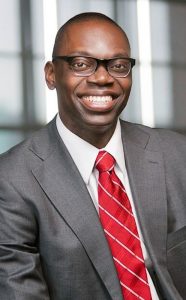
Adam Hollier (D)

Adam Hollier grew up in Detroit, raised in a family dedicated to service – his father a union firefighter and his mother a social worker. A lifelong Michigander, union member, and graduate of Detroit Public Schools, Adam has devoted his career to serving his community, from volunteering as a firefighter and disaster relief coordinator to enlisting as a paratrooper in the U.S. Army Reserve.

Adam has been a tireless advocate for fair representation and voter rights. As a Michigan State Senator, he fought for fair maps, protected the votes of Detroiters during the 2020 election, and championed investments in communities of color, job training, and critical public services. In 2023, as Director of the Michigan Veterans Affairs Agency, he expanded programs for veterans while continuing to uphold the democratic principles and freedoms that guide his lifelong public service.

Aghogho Edevbie (D)

Born and raised in Detroit, Aghogho Edevbie is the son of Nigerian immigrants who taught him the value of hard work and civic duty. His father worked 35 years at the Detroit Water Department, and his mother, a dedicated nurse, instilled in him the importance of voting – a lesson passed down from her own father during Nigeria’s first presidential election. Inspired by that legacy, Aghogho became an election protection lawyer while studying law at the University of Michigan, and later led All Voting Is Local in Michigan, helping pass Proposal 2 to expand voting access.

As Deputy Secretary of State, he helped implement those reforms and improve government services, cutting wait times and expanding online access. Now, ranked second in the nation for election administration, Michigan is proof of what people-centered leadership can achieve. Aghogho lives in Detroit with his wife Erin, and is running for Secretary of State to keep fighting for accessible, secure elections – and a democracy that works for everyone.

Barb Byrum (D)

Barb Byrum grew up in a working-class Michigan family, shaped by two of the strongest women in her life – her mother and grandmother – who instilled in her a deep sense of justice from an early age. Even as a child, she pushed for fairness, challenging school policies that excluded girls. She later became a small business owner, where she honed her commitment to customer service and learned to connect with people from all backgrounds.

Following in her mother’s footsteps, Barb ran for her State House seat at 28, serving as Caucus Vice Chair and Chair of the Agricultural Committee, where she championed small businesses, reproductive rights, and fair elections. As Ingham County Clerk, she modernized the office, saved taxpayer money, and led Michigan’s first 2016 recount with transparency and speed. Now, Barb is ready to take on election deniers and continue fighting for accessible, accountable government as Secretary of State – protecting rights, strengthening democracy, and delivering excellent service for all Michiganders.


Monica Yatooma (R)

Monica Yatooma has built her public profile on partisan activism rather than practical experience managing a large government office. While she emphasizes her background as a business owner and policy advocate, leading a small company and serving on local party boards offers little preparation for overseeing Michigan’s elections, voter registration, and statewide branch offices. Her campaign messaging focuses on ideological appeals like “election integrity” and parental rights, rather than concrete plans for running the office effectively.

Yatooma co-founded the far-right Great Schools Initiative (GSI), which pushes parents to use opt-out forms to exclude students from discussions of gender identity, sexual orientation, and LGBTQ+-inclusive education. The effort targets supportive school programs and staff while harming LGBTQ+ youth. She actively collaborates with partisan groups like Moms for Liberty and other conservative networks, prioritizing ideological messaging and media attention over the practical competence and impartiality needed to run one of Michigan’s largest and most complex state agencies.

Anthony G. Forlini (R)

Anthony G. Forlini, Macomb County Clerk, has faced scrutiny over his handling of election irregularities. In the August 2024 primary, four St. Clair Shores voters allegedly cast ballots twice – a felony in Michigan. Though state safeguards flagged the problem, a poll worker overrode the system and allowed the votes to count. Forlini defended the response as ‘transparent,’ but critics argue this downplayed the seriousness of the issue and exposed weak oversight under his watch.

While state officials emphasized that Michigan’s safeguards worked and that double voting is exceedingly rare, Forlini’s handling of the incident raised concerns about accountability. His rhetoric on “clean elections” contrasts with the reality that mistakes were allowed to slip through, fueling doubts about whether he would truly prioritize protecting voters and strengthening trust in democracy.

Timothy Smith (R)

Despite marketing himself as a “common sense” candidate, Timothy Smith’s platform is a blueprint for voter suppression dressed up as election integrity. His agenda leans heavily on fearmongering about voter fraud – a crime already exceedingly rare – to justify aggressive purges of Michigan’s voter rolls, expanded prosecutorial threats, and new hurdles that will overwhelmingly impact lawful voters. Smith’s proposal to automatically remove people from the rolls if they cannot be instantly “verified,” along with his push for rapid-fire purges of deceased voters and annual audits targeting so-called “fraudulent” entries, mirrors the same tactics used across the country to disenfranchise marginalized communities and restrict ballot access.

Amanda Love (R)

Amanda Love’s platform dresses up the election-denier agenda in bureaucratic language, but the goal is clear – making it harder for eligible Michiganders to vote. Her proposals rely on fearmongering about “inflated rolls” to justify constant voter purges, revived verification schemes known for wrongly flagging lawful voters, and surveillance-heavy rules for absentee ballots and drop boxes. These tactics mirror the national playbook used to weaponize election administration and suppress turnout among young voters, naturalized citizens, and communities of color.

PAID FOR BY THE DEMOCRATIC ASSOCIATION OF SECRETARIES OF STATE, 600 PENNSYLVANIA AVE SE UNIT 15180 WASHINGTON, DC 20003, NOT AUTHORIZED BY ANY CANDIDATE OR CANDIDATE’S COMMITTEE.